
Table of Contents
- Introduction
- What Makes PAN Card So Important in India
- Uses of PAN Card in Banking Services
- PAN Card Requirement for Bank Account Opening
- Uses of PAN Card in Loans & Credit Facilities
- PAN Card Role in Credit Cards & EMI Services
- Uses of PAN Card in Income Tax & Compliance
- PAN Card Uses in Salary & Employment
- Uses of PAN Card in Investments
- PAN Card in Mutual Funds & Stock Market
- PAN Card Uses in Insurance Policies
- PAN Card Uses in Property & High-Value Transactions
- PAN Card for Business & Self-Employed Individuals
- PAN Card Uses for Students & Young Adults
- PAN Card Uses for Senior Citizens
- What Happens If PAN Is Not Used or Not Available
- Legal Importance of PAN Card
- Common Misconceptions About PAN Card Uses
- Frequently Asked Questions (FAQs)
- Final Conclusion
1. Introduction
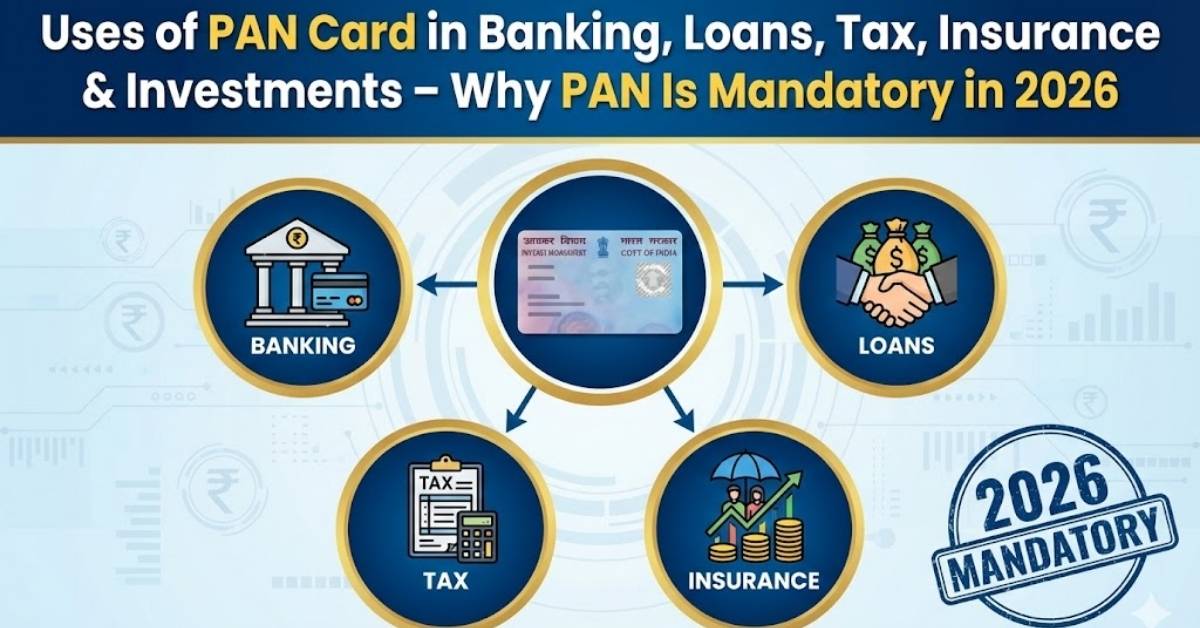
In India, the PAN Card (Permanent Account Number) is no longer limited to income tax filing alone. In 2026, PAN Card has become a core financial identity, required for almost every major transaction involving banks, loans, insurance, investments, employment, and high-value purchases.
Many people still assume that PAN Card is only for those who earn taxable income. However, even students, housewives, senior citizens, and individuals without income are now required to use PAN Card for basic financial services.
This detailed article explains the uses of PAN Card across banking, loans, tax, insurance, investments, business, and daily financial life, and why PAN is considered mandatory in India today.
2. What Makes PAN Card So Important in India
The Permanent Account Number (PAN) Card is one of the most essential identity and financial documents in India. Issued by the Income Tax Department, it acts as a unique identification number for individuals and entities while dealing with taxes, banking, and high-value financial transactions.
One of the main reasons the PAN card is important is its role in income tax compliance. It helps the government track income earned by a person and ensures transparency in tax payments. Filing income tax returns without a PAN card is not possible, making it mandatory for salaried individuals, professionals, and business owners.
The PAN card is also crucial for financial transactions. It is required while opening bank accounts, investing in mutual funds, shares, bonds, or fixed deposits, and while applying for credit cards or loans. For high-value transactions such as buying property, vehicles, or making large cash deposits, quoting PAN is compulsory to prevent tax evasion.
Another key importance of PAN lies in Aadhaar linking. Linking PAN with Aadhaar helps eliminate duplicate identities and ensures smoother processing of tax refunds, financial verifications, and government benefits. Without Aadhaar–PAN linkage, PAN may become inoperative, affecting all financial activities.
For businesses and professionals, PAN acts as a universal business identity. It is required for GST registration, TDS deductions, invoices, and compliance with various financial regulations. Even students and non-earning individuals are encouraged to apply for PAN, as it becomes useful for future financial needs.
Overall, the PAN card plays a vital role in maintaining financial discipline, preventing fraud, and enabling smooth participation in India’s formal economy. It is not just a tax document but a lifelong financial identity that supports banking, investments, and government compliance. 2026, most digital and offline systems are PAN-linked.
3. Uses of PAN Card in Banking Services
Banks require PAN Card to:
- Verify customer identity
- Track large deposits and withdrawals
- Comply with KYC regulations
- Report financial activity to authorities
Without PAN, banking services are limited or restricted.
4. PAN Card Requirement for Bank Account Opening
PAN Card is mandatory for opening:
- Savings account
- Current account
- Salary account
| Account Type | PAN Requirement |
|---|---|
| Savings Account | Mandatory |
| Current Account | Mandatory |
| Salary Account | Mandatory |
| Minor Account | PAN of guardian |
Without PAN, banks may refuse account opening or impose restrictions.
5. Uses of PAN Card in Loans & Credit Facilities
PAN Card is compulsory for:
- Personal loans
- Home loans
- Car loans
- Education loans
Lenders use PAN to:
- Check credit history
- Assess repayment capacity
- Prevent fraud
No loan application is processed without PAN.
6. PAN Card Role in Credit Cards & EMI Services
PAN is required for:
- Credit card issuance
- Buy-now-pay-later services
- EMI purchases
Financial institutions link PAN with credit score and repayment history.
7. Uses of PAN Card in Income Tax & Compliance
PAN Card is essential for:
- Filing income tax returns (ITR)
- Paying advance tax
- Responding to tax notices
- Claiming tax refunds
Without PAN, tax compliance is not possible.
8. PAN Card Uses in Salary & Employment
Employers require PAN Card to:
- Deduct TDS correctly
- Issue Form 16
- Report salary income
Without PAN, higher tax deduction may apply.
9. Uses of PAN Card in Investments
PAN Card is mandatory for:
- Mutual funds
- Shares and securities
- Bonds and debentures
- Fixed deposits above limits
Investment platforms use PAN to track gains and losses.
10. PAN Card in Mutual Funds & Stock Market
| Investment Type | PAN Requirement |
|---|---|
| Mutual Funds | Mandatory |
| Shares (Equity) | Mandatory |
| IPO Applications | Mandatory |
| Demat Account | Mandatory |
Without PAN, investors cannot participate in capital markets.
11. PAN Card Uses in Insurance Policies
PAN Card is required for:
- Life insurance
- Health insurance
- Motor insurance (high value)
Insurance companies use PAN for:
- KYC verification
- Claim settlement
- Premium payment tracking
12. PAN Card Uses in Property & High-Value Transactions
PAN is mandatory for:
- Buying or selling property
- Vehicle purchase above limits
- High-value cash transactions
PAN helps authorities monitor large financial movements.
13. PAN Card for Business & Self-Employed Individuals
Business owners use PAN for:
- GST registration
- Business bank accounts
- Tax filings
- Vendor payments
For freelancers, PAN is required for receiving payments without higher TDS.
14. PAN Card Uses for Students & Young Adults
Students require PAN for:
- Opening bank accounts
- Scholarships
- Education loans
- Long-term investments
Applying early avoids future financial issues.
15. PAN Card Uses for Senior Citizens
Senior citizens use PAN for:
- Pension income
- Fixed deposit interest
- Tax exemption claims
- Insurance benefits
PAN ensures proper tax calculation.
16. What Happens If PAN Is Not Used or Not Available
If PAN is not available:
- Bank services may be restricted
- Higher tax deduction applies
- Loan and investment applications get rejected
PAN is now unavoidable in financial life.
17. Legal Importance of PAN Card
Under Indian law:
- One person can hold only one PAN
- Quoting PAN is mandatory for notified transactions
- Misuse or duplicate PAN attracts penalties
PAN has legal recognition.
18. Common Misconceptions About PAN Card Uses
| Myth | Reality |
|---|---|
| PAN only for taxpayers | Required for all |
| PAN not needed without income | Needed for banking |
| e-PAN not valid | Fully valid |
Understanding correct usage avoids confusion.
19. Frequently Asked Questions (FAQs)
Is PAN required if income is below taxable limit?
Yes, for many financial activities.
Can I invest without PAN?
No, PAN is mandatory.
Is PAN required for insurance?
Yes, in most cases.
20. Final Conclusion
In 2026, the PAN Card is the backbone of India’s financial system. From banking and loans to tax, insurance, investments, employment, and property transactions, PAN Card plays a central role in ensuring transparency and compliance.
Whether you are a student, salaried employee, business owner, or senior citizen, having and using a PAN Card correctly is essential for smooth financial operations. Ignoring PAN requirements can lead to rejected applications, higher taxes, and restricted services.
A PAN Card is no longer optional—it is a financial necessity in modern India.